A Kick to Touch or a Kick for Distance?
A kick to touch or a kick for distance changes where rugby resumes and which phases follow. Learn how the restart, possession and chase shape the choice.
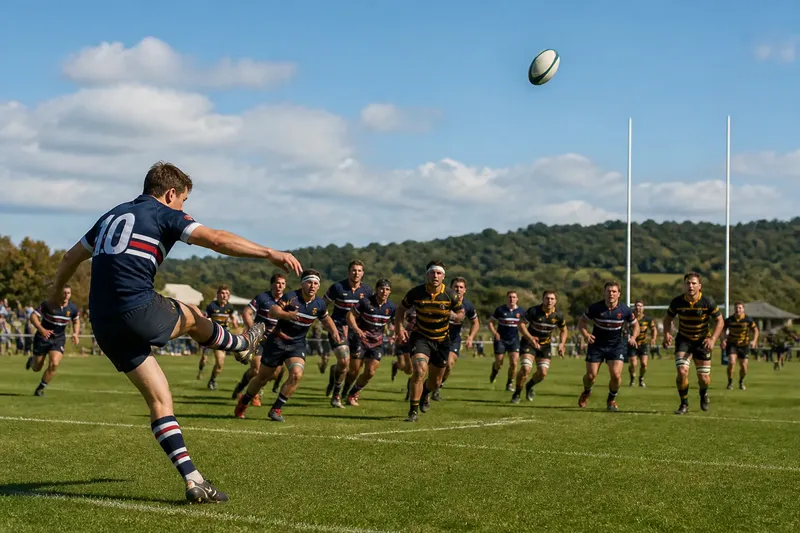
A kick to touch or a kick for distance changes both the next restart and the opponent’s options. In rugby, a kick to touch usually ends open play for a lineout, while a kick that stays in the field leaves the receiving team able to run, pass or kick in reply.
The distinction is not simply between a short kick and a long one. Touch trades the chance of an organised lineout for a stoppage; a kick kept in play trades that stoppage for a possible chase and continuing possession for either side.
Compare the outcomes
- Kick into touch: Play stops and a lineout is usually the next restart. The team awarded the throw depends on how and where the ball was kicked, including whether it went directly into touch and whether a territorial exception applies.
- Kick kept in play: Play continues when the ball lands or is gathered in the field. The receiving team can run it back, pass or kick again; the kicking team’s next opportunity depends on whether its chasers can apply pressure or compete for the ball.
- Touch near the opposition’s goal line: The restart may provide an attacking lineout, but the attacking side must still win the throw and execute its set piece. Farther from the goal line, touch can instead be a way to move play away from danger.
- Long kick into space: The receiver may have to turn and retreat, giving a connected chase a chance to close in. If the receiver has time and support, the same kick can offer an easy counterattack.
For a kick from open play that travels directly into touch, the usual outcome is a lineout opposite the place where it was kicked, with the receiving team throwing in. A relevant exception applies when the kicker is outside their own twenty-two-metre area: the lineout is generally opposite where the ball first crossed the touchline, not where it was kicked. If the ball bounces in the field before going out, the lineout is opposite where it crossed the touchline. Restarts and other situations can have different outcomes, so check the current laws and competition rules when a particular case matters.
Read the field position
Choose touch when the likely lineout is useful and the team is prepared to play it. A set piece makes the next contest easier to anticipate, but it does not ensure that the kicking team will have the throw or win possession.
Choose a kick that stays in play when space behind the receiver looks useful and the chase can arrive together. The kick may force the receiver to turn, but it does not remove their chance to return the ball. A lone chaser can leave teammates exposed to a counterattack.
Also look at the players already in position. A team with forwards moving towards a likely lineout may be ready to compete after a touch kick; a team spread across the pitch may be better placed to form a connected chase. Wind, the kicking angle and the receiver’s support all affect the likely result.
Match the kick to support
Before kicking to touch, the team should know what it wants from the lineout: a throw it expects to contest, a chance to launch an attack, or a chance to relieve pressure. Before kicking long into the field, the kicker should see whether teammates can advance together and cover the receiver’s likely choices.
Say a team has a penalty in its own half, a strong lineout unit and forwards already moving towards the touchline. If its aim is to move play upfield and set up a lineout, the kicker can aim for touch; the expected sequence is a stoppage, a lineout and then a set-piece contest. If those forwards are instead spread out and the opposing backfield has open space, a kick kept in play may invite a chase, but the team must accept that the receiver could counterattack if the chase arrives late.
The trade-off is not worth overcomplicating with guesses about the exact landing point. First identify the likely restart or possession, then check whether the players are organised for it. A precise-looking kick is of little use if the team has not prepared for the phase that follows.
Questions about rugby kicks?
Does a kick into touch always give the kicking team the throw?
No. In open play, a direct kick into touch will usually give the receiving team the throw, subject to the territorial exception and the circumstances of the kick. If the ball bounces in the field before going out, the lineout is generally opposite where it crossed the touchline.
Why kick long if the opponent may catch the ball?
A long kick can make the receiver turn or retreat and give a coordinated chase time to close space. If the receiver has room and support, though, they may run the ball back or kick in reply.
When is a kick to touch more useful?
It can suit a team that wants a lineout in a useful area or needs to move play away from its own end. Its value depends on who receives the throw and whether the team is ready for the set piece.
What should a new spectator watch?
Watch whether the ball goes out directly or bounces first, then notice who throws into the lineout. For a kick that stays in play, look at whether the chasers arrive together and what the receiver can do with the ball.
Judge the next phase
For a kick to touch or for distance, the useful question is what happens next: a lineout, a chase, a counterattack or a clearance from pressure. Read the restart, possession and chase as separate parts of the decision, and the purpose of the kick becomes easier to see.
Even a well-judged kick can produce an unexpected bounce or a contest that changes possession. The clearest sign of a sound choice is that the team has organised for the likely outcome rather than relying on the ball’s landing place alone.