The Advantage Signal: What the Referee Is Waiting to See
Rugby advantage explained: learn how referees assess possession, pressure and practical options after an infringement, and why play may return to the offence.
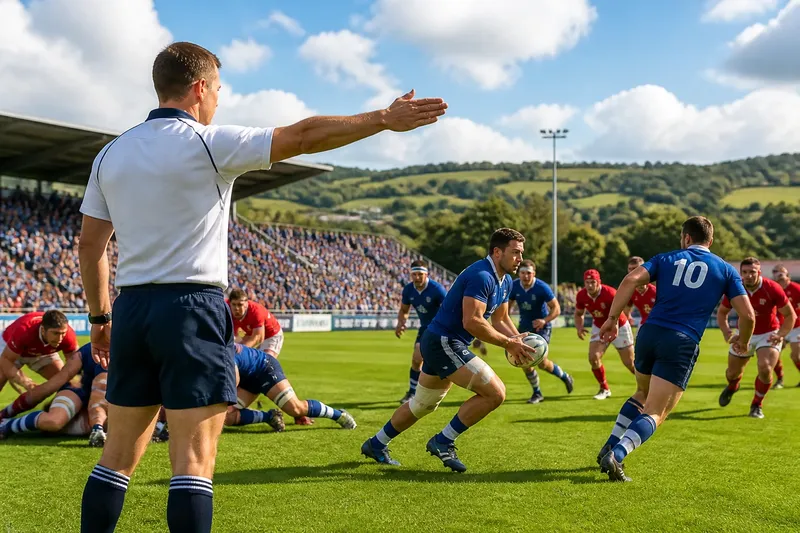
Rugby advantage lets the non-offending team continue after an infringement, but the arm signal does not mean that team has already gained a benefit. Rugby advantage is judged in context: the offence, the developing play and the applicable law all matter.
When a referee extends an arm towards the team that did not offend, watch what that side can do next. If the referee judges that no useful benefit has emerged, play may be stopped and brought back to the original infringement.
Read the signal
The referee normally signals advantage by extending one arm horizontally towards the non-offending team. The official may also indicate the offence or its location, and the signal can remain visible while play develops.
Advantage is permission to play on temporarily, not a penalty in itself or a promise that the team will score. The referee decides whether the team has had a sufficient opportunity to benefit, or whether play should return to the original offence.
Identify the offence
A knock-on or forward pass is different from a penalty offence such as offside or a high tackle. The applicable law and the circumstances determine the restart and what kind of benefit may satisfy the referee.
After a handling error, the referee may consider whether the non-offending side has gained possession and a practical chance to play. For a penalty offence, the referee assesses whether the continuing play has given that side an advantage comparable to what it could have chosen from the penalty. That assessment is not simply a matter of allowing extra time: the referee applies the relevant law to the situation as it unfolds.
From the stands, the offence may not be clear. Listen for the referee’s call or look for a gesture identifying the infringement; if neither is easy to see, treat the arm signal as a cue that play is continuing under the referee’s judgement.
Follow possession and pressure
Track who has the ball, how much pressure they face and which practical choices are available. A small gain in territory may leave a team pinned down, while a modest movement may still open a clear attacking option.
Imagine blue loses possession when red knocks the ball on, then blue gathers the loose ball. Blue passes into space and begins a coherent attack; the referee may judge that the handling advantage has been realised. If blue collects the ball but is immediately trapped with no useful option, the referee may instead stop play and return to the knock-on.
The number of passes or the time elapsed does not decide the matter by itself. The useful question is whether the team has gained a practical benefit under the circumstances and the relevant law.
Compare the judgements
After a knock-on, possession and a realistic opportunity to attack may be relevant signs of advantage. Following a penalty offence, merely touching the ball or making a small gain may not provide the team with a benefit comparable to the choices available from the penalty.
There is no single distance, number of phases or count of passes that settles every decision. The referee considers the team’s control, the pressure, the position of opponents and the available tactical choices, applying the law for that offence. Spectators can follow those factors, but the referee makes the judgement.
It is not worth trying to calculate a fixed distance or time from the stands. Those shortcuts miss the central question: what useful options did the team actually have under the applicable law?
What happens next?
Can advantage end without a score?
Yes. A useful attacking chance or tactical option may be enough for the referee to decide that the original offence need not be revisited. A try or a dramatic breakthrough is not required.
Can play return after several passes?
Yes, if the referee judges that the team has not gained an adequate benefit and the applicable law permits play to return to the original offence. Passes alone do not establish that advantage has been realised.
Does every infringement use the same test?
No. The visible signal can look similar, but the offence and relevant law affect what benefit the referee considers. A handling error and a penalty offence do not necessarily present the same options.
What should spectators watch?
Follow possession, pressure and the practical choices open to the non-offending side. These details are more helpful than judging the decision only by territory gained or by how long the arm remains raised.
Hear the referee
At a match, combine the arm signal with the referee’s voice, gesture and movement. An official may call advantage and identify the side or offence, while moving to keep the developing play in view.
Players may continue with a sensible attacking choice while remaining alert to a whistle. The defenders must keep playing too; they should not assume the original infringement has been put aside until the referee indicates that advantage has ended.
Rugby advantage is easiest to follow by identifying the offence, tracking the team’s control and choices, then waiting for the referee’s decision. That sequence keeps the focus on the benefit being judged, rather than treating the signal as a fixed promise or a timer.